
AI video fits Dubai real estate in three places: off-plan launch films built from the developer's approved renders, multi-language versions of the same listing for foreign buyers, and broker presenter videos at volume. Published Dubai rates are AED 3,500 per social asset and AED 15,000 to 60,000 per launch film, against AED 8,000 to 25,000 for a shot property video. Every ad, including on Instagram and WhatsApp, needs a Trakheesi permit number.
The market the video is selling into
Dubai recorded AED 419.94 billion of real estate transactions across 112,850 deals in the first half of 2026, according to Dubai Land Department data (source: Emirates 24|7). Sales were AED 286.44 billion through 86,000 deals, of which off-plan accounted for AED 139.75 billion across 58,840 transactions and completed properties AED 146.69 billion across 27,160.
Q1 alone was AED 252 billion across 60,303 transactions, up 31 percent in value year on year, with 29,312 new investors, up 14 percent, and foreign investment of AED 148.35 billion across 48,445 transactions (source: Dubai Land Department). Off-plan office sales in H1 reached AED 13.1 billion across 1,668 deals, more than the previous seven years combined (source: Emirates 24|7).
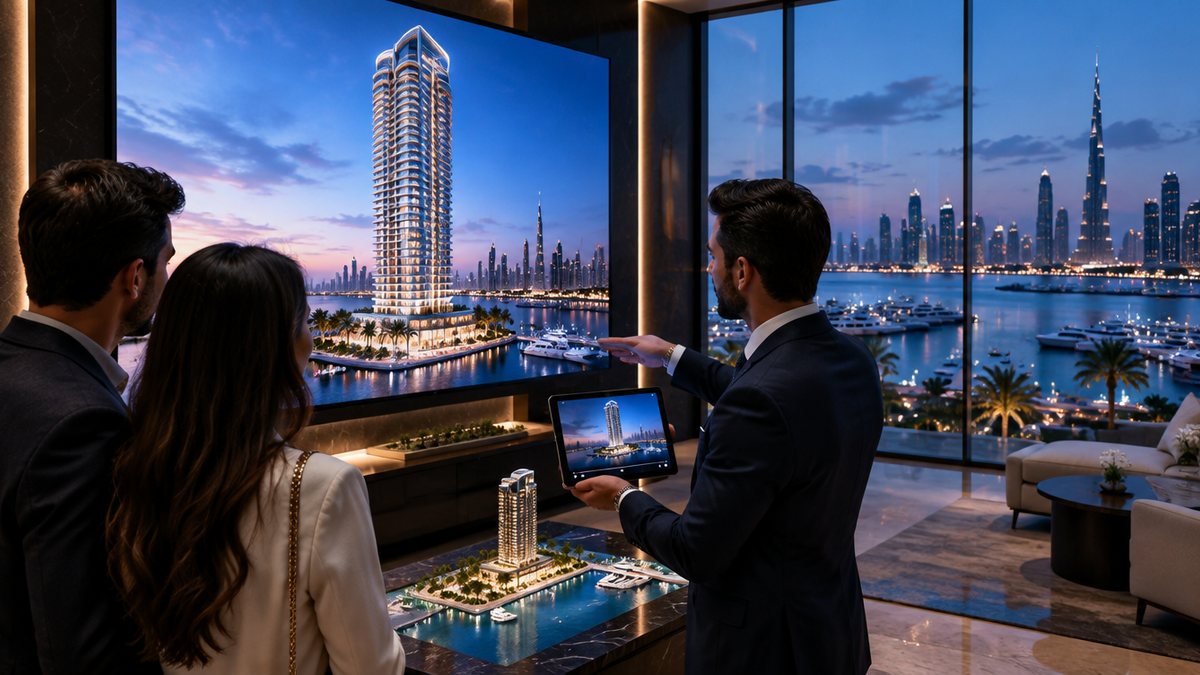
Two things follow for marketing. Most of the buyers are not in the room: they are abroad, deciding from a screen, in a language that may not be English. And more than two thirds of sales by count are off-plan, which means the product does not exist yet and every image of it is a render. Both are video problems, and the second is specifically a generated-video problem.
Where AI video fits, and where it must not
Use generated video for what cannot be filmed and for volume; use real footage for what a buyer will hold you to. Off-plan launches, area and lifestyle films, language versions and presenter videos are the fit. The unit itself, its finishes, its view and its floor plan must come from the developer's approved material or from real footage.
The regulatory reason is plain: the advert must match the permit (source: PropSpace), and the permit is issued against specific project material. The commercial reason is that a buyer who flies in and finds the balcony smaller than the video is a lost deal and a complaint. So the discipline is to generate context and motion, not facts about the property.
In practice, off-plan works like this. The developer's renders and plans become the source images. Image-to-video models add camera movement, time of day, people and life to the scene, and a 30 to 60 second hero film is cut from those shots. A multi-model workspace such as Higgsfield hosts Kling 3.0, Veo 3.1, Seedance 2.0, Sora 2 and Wan 2.7 for this in one login (source: Higgsfield).
What it costs against a shoot
A shot real estate video in Dubai is quoted at AED 8,000 to 25,000 (source: Four Kings UAE), before talent and permits, for one film of one property. AI production is published at AED 3,500 per short social asset and AED 15,000 to 60,000 for a branded piece, with hybrid campaigns from AED 80,000 (source: JJ Agency Films).
The difference is what the money buys. A launch at AED 60,000 in generated production is a hero film plus roughly a dozen cutdowns and hooks, each re-versioned per language; the same budget shot is two or three films. For a brokerage running twenty listings a month, AED 3,500 per social asset is the number that matters, and a presenter avatar amortises across all twenty.
Media is on top. Instagram impressions in Dubai run AED 15 to 40 per thousand, with a meaningful test at AED 2,000 to 4,000 a month and costs rising 30 to 60 percent in Ramadan, DSF and GITEX (source: GOAT Technologies). A launch that needs reach in Ramadan should have its assets finished before it starts.
Languages: the case for versioning over reshooting
Foreign investment of AED 148.35 billion in one quarter (source: Dubai Land Department) is the argument for every launch in more than one language from the start. One Dubai studio lists AI voiceover in Modern Standard Arabic, Gulf dialects, English, Hindi and Russian (source: JJ Agency Films), and generated footage is re-versioned per language without a reshoot.
For a broker, this is the practical use of an avatar: a presenter built from your own face and voice, with your written consent on file, that fronts every listing video in four languages without you re-recording. A release drafted for a traditional shoot may not cover synthetic recreation of a face or voice, so the release must say so explicitly (source: Lemonlight).
The GCC buyer deserves a line of its own. GCC nationals invested AED 12.23 billion in Q1 2026 across 3,228 investments (source: Dubai Land Department); Gulf-dialect voice rather than Modern Standard Arabic is a small production choice that reads as respect.
The Trakheesi rule, in full
Every property advertisement in Dubai needs a Trakheesi permit from Dubai Land Department, supervised by RERA, and that explicitly includes Instagram, Facebook, YouTube and WhatsApp, with no exemption for digital or informal formats (source: EGSH). The permit number must be displayed prominently on the ad, and the ad must match what the permit was issued for (source: PropSpace).
The permit costs AED 1,000 plus a AED 20 knowledge and innovation fee for standard types, AED 5,000 plus AED 20 for project launch events, across fourteen categories from portal and print listings to billboards, exhibitions and open days (source: PropSpace). Processing is within one working day, around eight hours for a complete submission (source: EGSH).
Fines are progressive and start at AED 50,000, with listing removal and licence cancellation for serious or repeat violations (source: EGSH). Separately, brokers need written authorisation from the owner before marketing a unit, formalised as Form A, the Real Estate Marketing Agreement, with fines up to AED 50,000 for breaches (source: Built Environment ME). Abu Dhabi runs its own system, Madhmoun, required since 7 July 2025, with no reciprocity (source: PropSpace).
Generated video changes none of this. It changes one thing in practice: the permit is issued against specific material, so the generated film must be built from that material, and the permit number belongs in the video itself, not only in the caption.
A launch plan for a developer or a brokerage
For an off-plan launch, plan four deliverables from one set of approved renders: a 30 to 60 second hero film; ten to twelve cutdowns and hooks in vertical and square; language versions in English, Arabic and whichever two markets the sales team is targeting; and a broker kit of short presenter clips per unit type. Permit first, then production.
For a brokerage, plan a monthly rhythm rather than a launch: a presenter avatar built once, a listing video template at AED 3,500 per asset, and the Trakheesi number and Form A reference attached to every file before it leaves the agency. Post in the buyer's language and time zone, and reply to the lead fast; the video's job is to earn the enquiry.
Expect labels on the platforms. Meta adds AI information to ads made with its generative tools and, since June 2026, to ads it detects were made with third-party tools (source: Meta). A label on an off-plan film is accurate and does no harm; a label on a completed unit that was actually generated is a problem, which is another reason to film what exists.
How NotBoring works with real estate clients
NotBoring is a Dubai creative production agency making cinematic and AI-generated video for brands across the GCC (source: NotBoring), so this is a seller's guide and the rates above are other studios' published prices, not ours. We quote on the brief: the project material, the languages, the number of assets and whether a real presenter appears.
Productions run on Higgsfield alongside conventional creative direction, the working standard is that a viewer cannot tell which shots were generated, and real people appear only under a signed release covering synthetic use. For teams that want the workflow in-house, NotBoring's in-person AI Video Production Workshop in Dubai teaches it.