
A restaurant or cafe in Dubai gets more from short, unpolished vertical video than from a glossy film: in Ramadan 2026, phone-filmed content with real people outperformed ads that looked like TV commercials, and 15 to 30 seconds beat longer formats. AI video fits for animating your real dish photos and generating the setting around them at AED 3,500 per asset. The food itself must always be real.
The competition for the same feed
Dubai has 8,617 restaurants and 5,240 coffee shops and cafeterias, per Dubai Municipality figures cited by the USDA, inside a UAE market of more than 17,300 outlets and USD 17.8 billion in food-service sales that the report calls highly competitive and increasingly value-seeking (source: USDA Foreign Agricultural Service). Most of those outlets promote on the same two apps as you.
That crowd sets the media price. Instagram impressions in Dubai cost AED 15 to 40 per thousand, Facebook AED 10 to 25, and the same benchmark names creative quality as the biggest lever on cost (source: GOAT Technologies). Costs rise 30 to 60 percent in Ramadan, Dubai Shopping Festival and GITEX, which for a restaurant means the busiest month is also the most expensive one to reach people.
Delivery changes the job of the ad. UAE food delivery apps fulfilled about 103 million orders in 2025, with active app-user penetration around 42 percent and an average order of USD 14.56 (source: Ken Research). A large share of customers never see the room, so the video has to sell the plate and the tap, not the interior.
What food video actually works, from Ramadan 2026
Short, vertical, early hook, captions, and less polish than you think. A Dubai agency reported that 15 to 30 second vertical videos on Instagram and TikTok outperformed longer formats in Ramadan 2026, with 20 seconds as the sweet spot, an emotional hook in the first 3 seconds and text overlays for silent viewing (source: JJ Agency Films).
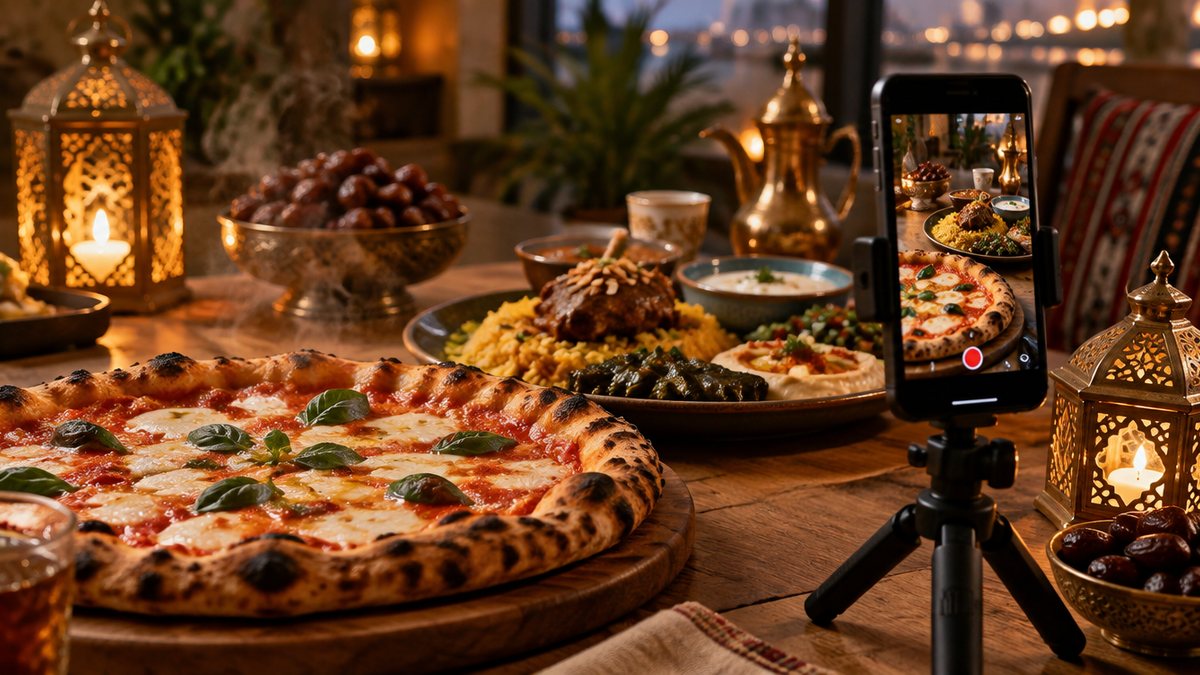
The same report found overly polished advertisements underperformed, and that phone-filmed content with real people beat traditional commercial-style ads. One restaurant client filmed iftar preparation on an iPhone with a small LED light; another's raw, family-iftar-preparation campaign became its best performing video of 2026 (source: JJ Agency Films).
Timing did as much as content. Posts published in the pre-iftar window, 30 to 60 minutes before sunset, and after taraweeh, 10pm to midnight, saw engagement increases of three times or more against standard business hours (source: JJ Agency Films). Outside Ramadan the same logic holds: post when people are deciding what to eat, not when the office opens.
Where AI fits, and the one rule that never bends
The dish in the ad must be the dish you serve. UAE media content has to meet 20 standards under the media law, with fines up to AED 1 million (source: Gulf News), and misleading food imagery is the fastest route to a refund and a one-star review. The rule for a restaurant: never generate the food.
What AI video is for is everything around the food. Take your own real photos of the plate and animate them: steam, a slow push-in, a hand reaching for a piece. Generate the setting: a table at golden hour, a family gathering, a delivery bag on a doorstep, the same dish in a lunch scene and an iftar scene. Generate the variations: five hooks, three formats, Arabic and English.
One Dubai studio's process shows the mechanics: reference frames locked to the brand, a first pass of typically 20 to 50 variants per shot, human curation, then sound, captions and final conform (source: JJ Agency Films). For a restaurant the reference frames are your photos, and the curation is whoever knows what the dish looks like.
What it costs against a shoot
A phone clip costs an afternoon. An AI-produced social asset is published at AED 3,500 by one Dubai studio (source: JJ Agency Films). A shot social video is quoted at AED 3,000 to 8,000, before talent at AED 1,000 to 5,000 per person per day and equipment at AED 2,000 to 20,000 a day (source: Four Kings UAE).
The shoot buys one thing well: a real chef, a real room, a real plate arriving at a real table. If your brand is the room, shoot it once a year and cut it into pieces. The AI route buys variety: the same signature dish in ten settings and two languages without booking a crew or closing the kitchen for a morning.
Media sits on top of either. A meaningful test is AED 2,000 to 4,000 a month in ad spend, with a floor of about AED 2,000 below which the results are noise (source: GOAT Technologies). For a single-location cafe, AED 2,000 in media behind one honest phone video is a better first month than AED 20,000 in production.
A month of content for one location
Plan four videos a month, one a week, each 15 to 30 seconds, vertical, captioned. Week one: the dish you most want to sell, price in the first second. Week two: the owner or chef saying why it is on the menu. Week three: a customer's problem in their words. Week four: the delivery offer, ending on the app link.
Make each in two or three variations rather than one perfect version. Meta's systems now test creative variety against itself, and practitioner guidance is 20 to 50 assets per ad set (source: AdMove); a cafe cannot feed that, but four dishes in three hooks each is twelve assets, which is a real test. At published AI rates, four assets a month is AED 14,000; at phone rates it is four afternoons.
Plan Ramadan separately and early. Assets finished before the month, iftar and suhoor offers as their own videos, posting scheduled for the pre-iftar and post-taraweeh windows, and Arabic and English from the first post.
The rules for a restaurant owner
Three rules, none hard. You can promote your own restaurant from your own account without the UAE advertiser permit; according to The National, it is not required for individuals promoting their own business through personal accounts, and it is required for anyone posting promotional content for others, paid or unpaid (source: The National). Every food creator you host needs one.
Claims must be true, and that includes the plate: 20 media standards, fines up to AED 1 million (source: Gulf News). If your chef or staff appear in generated footage, get a written release that names AI use. And expect a label: Meta adds AI information to ads made with its generative tools and, since June 2026, to ads it detects were made with third-party tools (source: Meta). An honest ad survives a label.
How NotBoring works with restaurants
NotBoring is a Dubai creative production agency making cinematic and AI-generated video for brands across the GCC; Maestro Pizza is a client (source: NotBoring). This is a seller's guide and the rates above are other studios' published prices, not ours. We quote on the brief: the dishes, the number of assets, the languages and whether anyone real appears.
The working standard is that a viewer cannot tell which shots were generated and that the food is never one of them. For an owner who would rather do it in-house, the same workflow is taught in NotBoring's in-person AI Video Production Workshop in Dubai, and the honest first step is still a phone, one dish and AED 2,000 in media.