
AI-generated training videos in Dubai replace most of the per-module production cost, AED 8,000 to 15,000 for a straightforward filmed module and AED 25,000 to 50,000 for a scenario-based one, with a platform subscription of about USD 24 to 29 a month plus scripting time.
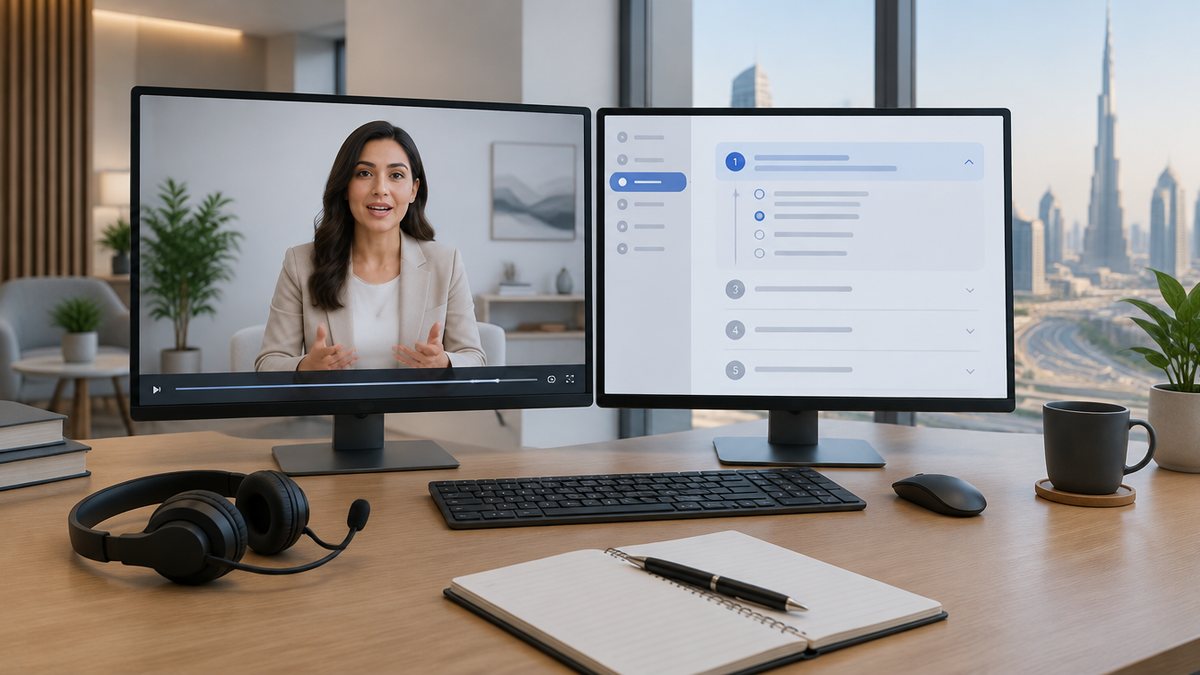
L&D teams report production time falling 62 percent, from 13 days to 5. What no one has shown is that the resulting videos teach better.
What training video costs in the UAE today
Filmed e-learning in the UAE is quoted per module, and the range reflects how much production the module needs. Straightforward content runs AED 8,000 to 15,000 per module; scenario-based productions with actors, multiple locations and interactive elements run AED 25,000 to 50,000.
A comprehensive programme of 10 to 20 modules therefore represents AED 100,000 to 400,000 in production investment (source: UAE Free Zone Finder).
Corporate video more broadly in Dubai sits in three bands: roughly AED 10,000 to 20,000 for a short single-location piece over two to three weeks, AED 25,000 to 50,000 for the professional middle over four to six weeks, and AED 60,000 to 100,000 and up for flagship work over eight to twelve weeks, with revisions at AED 3,000 to 5,000 per round beyond those included (source: JJ Agency Films).
Two line items in those quotes disappear with generated production and are worth noting because they recur per module: talent at AED 5,000 to 15,000 a day and voice-over at AED 3,000 to 8,000 (source: JJ Agency Films). A twelve-module programme pays them twelve times.
What the L&D field actually reports
Adoption is now majority. Around half of L&D teams used AI to make video in 2026, 52 percent in Synthesia's AI in L&D Report, and 88 percent say the main value is time saved on content creation.
Practitioners report average production time for a training video falling 62 percent, from 13 days to 5, and nearly a third of teams now make more than 21 training videos a month (source: Dr Philippa Hardman).
The cost comparison those teams cite is stark: traditional production at USD 1,000 to 10,000 per finished minute against roughly USD 1 to 3 per finished minute on an AI platform (source: Dr Philippa Hardman, citing Clutch). Platform pricing supports it: HeyGen's Creator plan is about USD 24 a month and Synthesia's Starter about USD 29, with enterprise tiers adding 4K export and SCORM integration (source: HeyGen).
The same analysis makes the point that matters most, though, and it is not a cost point.
The uncomfortable finding
No published evidence shows that AI-generated video improves learning outcomes. The statistics the category reports are all production statistics: adoption, speed, volume, cost per minute. Forty years of learning research points elsewhere, to instructional design, practice and feedback as what determines whether anyone learns anything (source: Dr Philippa Hardman).
That is the honest frame for any L&D team considering this. AI changes what a module costs and how fast it ships. It does not change whether the module teaches, and making bad modules faster produces more bad modules. One directory now tracks 123 AI video generation tools, 108 added in a single year (source: Dr Philippa Hardman); none of them writes a good module.
The practical implication is a budget shift rather than a budget cut. Money that used to go to crew and talent should go to instructional design, scenario writing, assessment and translation, which is where learning outcomes actually move. A team that pockets the whole saving ends up with cheaper video and the same training problem.
Which modules suit an AI presenter
Pick by how often the content changes and how much the presenter's identity matters. Strong fits: onboarding and induction, compliance refreshers, system and software walkthroughs, product knowledge, policy updates, safety basics. These change often, need consistency across hundreds of staff, and do not depend on who is delivering them.
Weak fits: anything where a real leader's credibility is the message, such as a CEO's culture piece; hands-on physical demonstration where the camera must show real equipment and real hands; nuanced interpersonal scenarios where performance carries the learning; and culturally sensitive material where a real, known face carries the trust.
The practical limit from the tools themselves: keep each generation under 30 seconds and cut between them, because gesture repetition accumulates and becomes visible in longer takes (source: Higgsfield). A ten-minute module is not one render; it is a sequence of short takes, screen recordings and graphics assembled like any other edit.
Where it genuinely pays: the update
The strongest case for AI training video is not the first version, it is the second. A policy changes, a system gets a new interface, a regulation is updated, and a filmed module becomes a reshoot: crew, talent, location, edit. A generated module becomes a script edit and a re-render, with the same presenter, voice and template.
For a UAE employer that is a recurring saving, because compliance and systems content changes annually or faster. It also fixes the quiet failure mode of filmed training libraries: modules that are out of date because nobody could justify reshooting them, teaching staff the wrong process from a video the company paid AED 15,000 for.
Build for that from the start. One presenter, one template, one voice, modular scripts that can be edited section by section, and a version record showing what changed and when. The reuse is the return.
Arabic, and the rest of a UAE workforce
Language is where UAE training differs from the global case studies. Plan English and Arabic from the start, and consider Hindi, Urdu or Tagalog depending on the teams. Generated production makes those versions cheap, which is often the deciding argument for a frontline workforce.
The Arabic method is two steps, because the main video models do not generate Arabic dialogue natively. Generate the voice first in a text-to-speech model that supports Gulf or Modern Standard Arabic, then lip-sync the presenter to it (source: ElevenLabs; source: NotBoring). Use Modern Standard for formal compliance material and Gulf dialect for conversational content, and have a native speaker read the script aloud before generating.
Consent, if the presenter is a real employee
Using a staff member as the on-screen presenter needs written consent that explicitly covers synthetic use of their face and voice, not a release written for a normal shoot. UAE law penalises content that breaches privacy or damages reputation with fines from AED 150,000 to 500,000 (source: Baker McKenzie).
There is also a practical problem: people leave. An avatar of a departed employee still fronting the induction module is awkward at best, and the consent may not survive the exit. A licensed or invented presenter avoids both the consent chain and the resignation problem, and most UAE employers end up there.
How NotBoring approaches training content
NotBoring is a Dubai creative production agency making cinematic and AI-generated video for brands across the GCC, so this is a seller's guide with other studios' published rates.
For training work we start from the module map and the update cycle, build one presenter and template to reuse across the programme, produce Arabic by generating the voice first, and say plainly when a module needs a camera and a real person instead.
For teams that want the capability in-house, the same production workflow is taught in NotBoring's in-person AI Video Production Workshop in Dubai, and the instructional design stays with your L&D team, where it belongs.