
An AI explainer video in Dubai costs AED 3,500 per social asset or AED 15,000 to 60,000 for a branded piece at published rates, against AED 15,000 to 45,000 for a 60 to 90 second animated explainer from a studio. The real choice is not price.
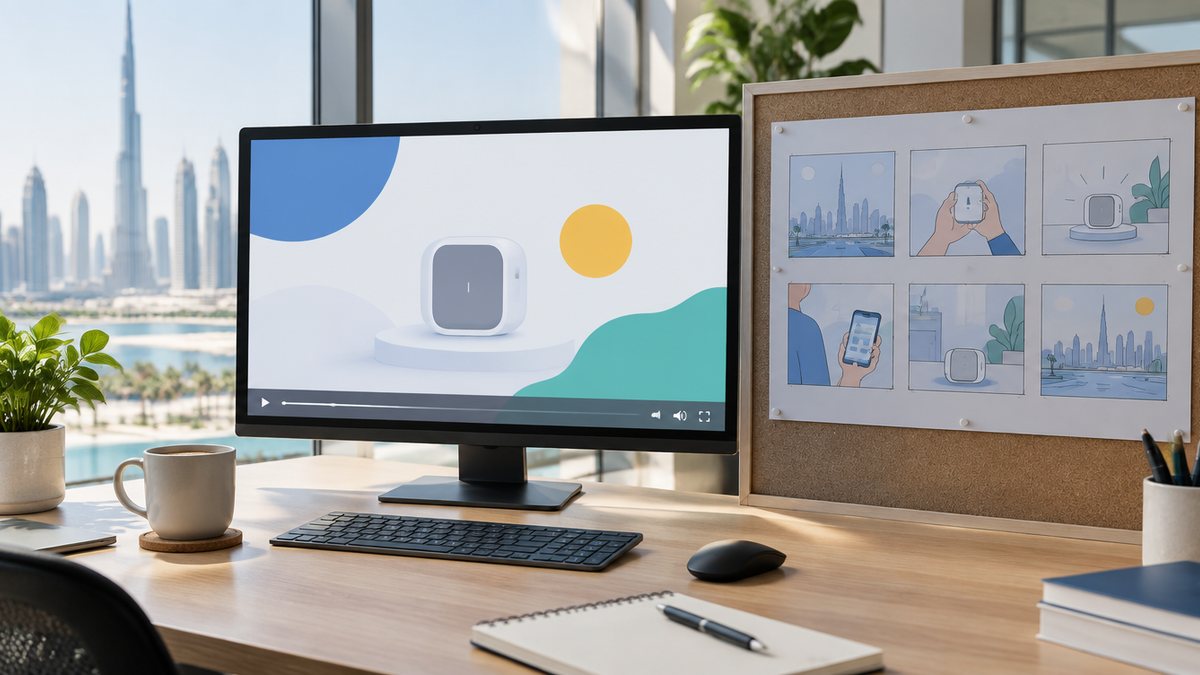
AI generation makes live action: people, places, products. Animation makes what cannot be photographed: software, data, processes, ideas. Pick by what you are explaining.
The two kinds of explainer, and which you need
Decide this before you get quotes, because it decides everything else. If your explanation involves a person, a place or a physical product, generated live action fits: a customer with a problem, a service happening in a real setting, a product in a real hand.
If it involves software, data, a process or an abstraction, animation fits, because none of those can be filmed and all of them can be drawn.
Most Dubai briefs that say "explainer" are actually the second kind. A bank explaining a product, a logistics firm explaining a route, a SaaS company explaining a dashboard: those need arrows, labels, diagrams, a UI that moves. Generated video is a poor substitute for that, and the current models' weakness with on-screen text makes it worse.
The hybrid is common and usually right: a generated or filmed opening that shows the human situation, then motion graphics for the mechanism, then a generated close. The script decides the split, not the production method.
What each costs in Dubai
Animation in Dubai is priced per finished minute, and the style sets the rate. Motion graphics run AED 800 to 1,500 per minute, whiteboard animation AED 900 to 1,600, and character-driven 2D AED 1,800 to 3,000, with a general range of AED 800 to 3,500 depending on complexity (source: Chasing Illusions).
A complete two-minute project including script, storyboard, design, animation, voice and audio totals AED 7,250 to 17,600.
Full studios quote higher for a finished explainer: a 60 to 90 second piece typically runs AED 15,000 to 45,000 depending on style, length and revision rounds. Multilingual voiceover is quoted separately at AED 600 to 2,500 per minute, and rush turnarounds add 25 to 45 percent (source: Chasing Illusions).
AI production is published at AED 3,500 per short social asset of 15 to 60 seconds and AED 15,000 to 60,000 for a branded or product piece (source: JJ Agency Films). Those numbers overlap with animation at the branded tier, which is the point: for a single polished explainer the methods cost similar money, and the choice should be made on fit. The gap opens with volume and languages.
Where the AI route actually saves
Not on the hero film; on everything after it. One explainer rarely stays one explainer: a SaaS company wants a version per industry, a clinic wants one per treatment, a developer wants one per language. Traditional animation re-opens the project file and re-renders; a shoot goes back on location. Generated footage re-versions from the same shotlist.
The second saving is language. Multilingual voiceover alone runs AED 600 to 2,500 per minute in Dubai (source: Chasing Illusions), and a filmed presenter has to be re-shot or dubbed. Generated versions change the voice and the lip sync without touching the picture. For a UAE brand that needs Arabic and English as a baseline, that is the whole business case.
The third is iteration speed. One Dubai studio publishes 5 to 10 business days from brief to final delivery for a branded AI video (source: JJ Agency Films), against two to four weeks for a 2D explainer where every frame is built. The time saved is in production only; scripting and approvals take exactly as long as they always did.
The Arabic question
Arabic is where the method shows. The main video models do not generate Arabic dialogue natively: Kling 3.0's native audio covers Chinese, English, Japanese, Korean and Spanish (source: Kling), and Veo 3.1 generates dialogue without Arabic among its documented languages (source: Google). So an Arabic explainer is made in two steps.
Generate the voice first, in a text-to-speech model that supports the dialect you need. ElevenLabs' Multilingual v2 lists Arabic for Saudi Arabia and the UAE and advises matching the voice accent to the target region (source: ElevenLabs). Then lip-sync the presenter to that audio. The full workflow, with credit costs, is in the sound and voice guide (source: NotBoring).
One practical rule from client work: have a native speaker of the target dialect read the Arabic script aloud before anything is generated. Arabic written for the page and Arabic written for the ear are different scripts, and an explainer lives or dies on the second.
How to brief one that works
An explainer fails for script reasons, not production reasons, and the most common failure is explaining the product instead of the problem. The structure that works is four beats in 60 seconds: the viewer's situation in their words, what goes wrong today, what changes, what to do next. The brand arrives in the last ten seconds.
Sixty seconds is about 150 words of script, which is the useful constraint. It forces one idea, one audience and one action. If the script will not fit, the brief contains two explainers, and the right move is to make two rather than one long one. Social cuts of 15 to 30 seconds come out of the same script.
Send an agency six things and the quote will be accurate: the one thing being explained, who it is for in plain words, whether it needs to show software or people, the languages, where it will run, and how many versions you expect in the first year. That last item is what decides whether AI, animation or a hybrid is the cheaper answer.
What to expect in the deliverable
A finished explainer should arrive as a 16:9 master, 9:16 and 1:1 cuts, captions burned in and as a separate file, each language as its own set, and the source project or shotlist so the next version does not start from zero.
Ask for the shotlist specifically; it is what makes version two cost less than version one.
Expect a platform AI label on paid distribution. Meta adds AI information to ads made with its generative tools and, since June 2026, to ads it detects were made with third-party tools (source: Meta). An explainer that is honest about what it explains survives a label without any trouble.
How NotBoring approaches explainers
NotBoring is a Dubai creative production agency making cinematic and AI-generated video for brands across the GCC, so this is a seller's guide with other studios' published rates.
For explainers we start from the script and the version count, recommend animation or a hybrid when the subject is software rather than people, and produce Arabic by generating the voice first.
Quotes follow the script length, the number of versions and the languages, not a per-minute card. The wider price picture by deliverable is in the cost guide (source: NotBoring).