
AI video for a Saudi brand uses the same workflow as Dubai with four additions: the Mawthooq licence for any paid creator who posts it, SDAIA's 2026 deepfake guidelines requiring explicit consent and visible watermarks, the PDPL's treatment of faces and voices as sensitive data, and Gulf-dialect Arabic generated as voice first and lip-synced second.
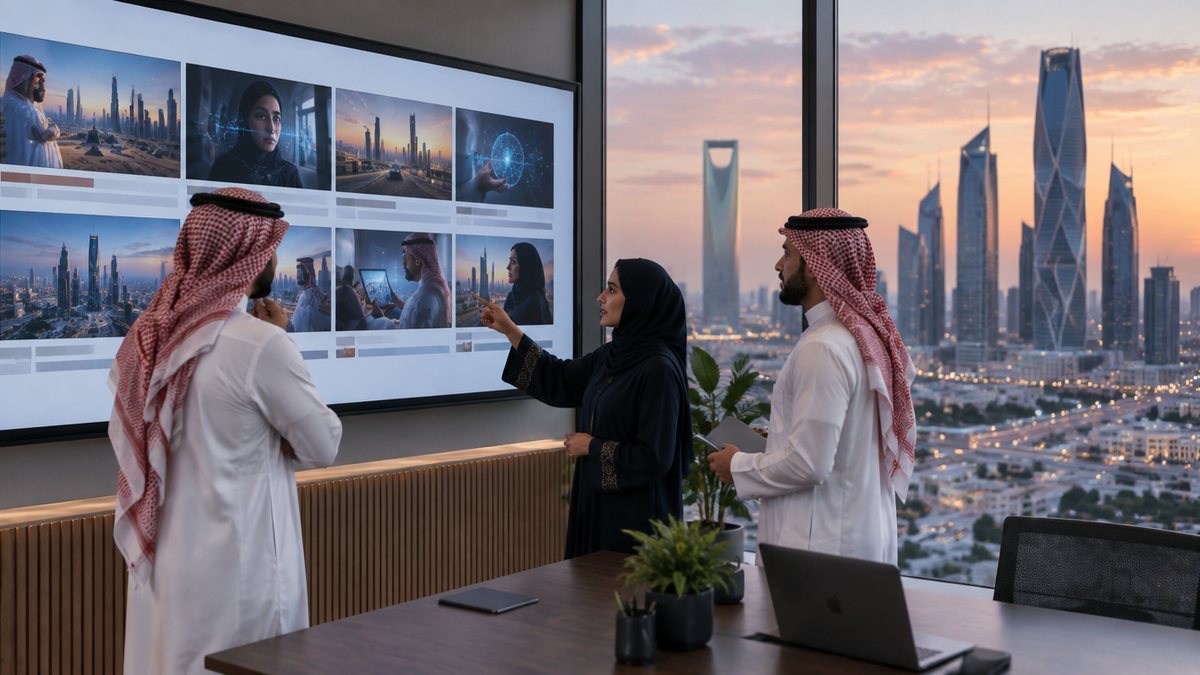
The market behind it is USD 4.68 billion of digital ad spend in 2026, growing faster than the UAE's.
The market, and why the brief usually comes from Riyadh
Saudi Arabia is the largest and fastest-growing digital ad market in the GCC, which is why a UAE agency's biggest briefs increasingly land from Riyadh and Jeddah. Digital ad spend in the Kingdom is forecast at USD 4.68 billion in 2026, up 16.8 percent, and USD 7.98 billion by 2029 at 19.4 percent a year (source: Research and Markets).
IAB MENA put Saudi digital advertising growth at 23.5 percent in 2024 (source: Communicate Online).
Two things follow for production. Volume: a market growing that fast needs more creative than shoots can supply, which is the case for generated production. And localisation: a campaign built for the UAE rarely travels to Saudi Arabia unchanged, and generated footage lets the Saudi version have its own casting, settings and dialect on the same shotlist rather than a dubbed Dubai spot.
Rule one: the Mawthooq licence for anyone paid to post
The video does not need a licence; the person who posts it for money does. Saudi Arabia's media regulator introduced the Mawthooq licence in 2022 for individuals, Saudi or resident, who earn revenue from advertising content on social media (source: Arab News).
Rules took effect on 1 October 2022, and the regulator, formerly GCAM, now operates as the General Authority of Media Regulation (source: General Authority of Media Regulation).
Two practical points for a brand running AI video through creators. Every creator paid to post must hold the licence, so confirm it before signing. Non-resident creators cannot hold it directly; they work through a Saudi agency registered in Mawthooq, which carries the compliance responsibility (source: Miqwal). A brand posting from its own account is outside the requirement.
The fee is reported differently across sources: SAR 15,000 for three years at launch (source: Arab News), while a 2026 guide reports registration as free with associated commercial-registration fees, and cites fines of up to SAR 500,000 for non-registration and SAR 300,000 for undisclosed advertising (source: Miqwal). Check the authority's current page before budgeting; the requirement itself is not in doubt.
Rule two: SDAIA's deepfake guidelines
Saudi Arabia published the region's clearest rules for synthetic media in May 2026, and they treat marketing as a legitimate use with conditions. SDAIA's "Deepfakes Guidelines: Mitigating Risks While Fostering Innovation" state that the technology is not inherently harmful and that intent and application determine its impact, listing marketing, entertainment, retail, education, healthcare and culture as non-malicious applications (source: Arab News).
The conditions are specific. Creators must secure explicit consent before using any individual's likeness and keep auditable records; creators must apply visible, tamper-resistant watermarks to synthetic content, and developers must embed non-intrusive digital watermarks; and the guidelines recommend content provenance standards such as those of the Coalition for Content Provenance and Authenticity (source: Arab News). Developers are also directed to the PDPL and the Anti-Cyber Crime Law.
For a brand this means three production habits. A consent record for every real person, before generation. A visible label or watermark designed into the frame rather than left to the platform. And content credentials attached to the export, which TikTok and others read to apply their own labels. None of these is hard; all of them are new to teams used to a Dubai-only workflow.
Rule three: the PDPL treats a face as sensitive data
A face, a voice or any biometric identifier is sensitive personal data under Saudi law, and the authority is enforcing. The PDPL took effect on 14 September 2023; sensitive data includes biometric data, fines reach SAR 5 million, and unlawful disclosure of sensitive data carries up to SAR 3 million and two years' imprisonment (source: DPO Consulting).
SDAIA's committees issued 48 enforcement decisions in the first year of adjudication, and a significant share involved marketing and promotional messages sent without prior consent, particularly in retail, telecoms and financial services (source: IAPP). The lesson transfers directly to AI video: a real employee's face in a generated ad is biometric data processed for marketing, and it needs a lawful basis, which in practice means explicit written consent.
The clean route is the one NotBoring uses in the UAE: invented or licensed characters and library voices unless a signed release covering synthetic use exists. For a Saudi campaign, add the consent record to the asset register, keep it for the campaign's life, and check whether any footage or reference images leave the Kingdom, since the PDPL restricts cross-border transfer to necessary and protected cases (source: DPO Consulting).
Voice and dialect: Gulf Arabic, generated first
Saudi audiences hear the wrong Arabic in a sentence, and the main video models do not speak Arabic natively yet, so voice is the part of a Saudi campaign that changes most. Kling 3.0's native dialogue covers Chinese, English, Japanese, Korean and Spanish (source: Kling), and none of the native-audio models lists Arabic.
The working method is two steps: generate the voice in a text-to-speech model that supports Arabic, then lip-sync the face to it.
ElevenLabs' Multilingual v2 lists Arabic for Saudi Arabia and the UAE and advises choosing a voice with an accent matching the target region (source: ElevenLabs). Use Gulf Arabic for spoken lines to consumers, Modern Standard Arabic for government, corporate or pan-Arab messaging, and have a Saudi native speaker read the script aloud before anything is generated. One Dubai studio lists Gulf dialects among its AI dubbing deliverables (source: JJ Agency Films); the dialect is a production choice, not a translation setting.
Casting and setting change with the voice. A Saudi campaign wants Saudi-looking presenters, Riyadh and Jeddah streets, Saudi retail interiors and Saudi dress conventions, all of which are exactly what generated production changes cheaply on an existing shotlist. The full sound workflow, including costs per second, is in the guide to sound, voice and lip sync (source: NotBoring).
Calendar and budget
Plan the Saudi calendar first and the budget second. Ramadan and the two Eids move every year; Saudi National Day is 23 September and Founding Day 22 February; Riyadh Season runs from October. Assets should be finished before each window, because approvals slow and media costs rise inside them.
A Saudi campaign made in generated footage can have its Ramadan set, its National Day set and its evergreen set from one character system.
For budget, the published Dubai rates are the starting point: AED 3,500 per social asset, AED 15,000 to 60,000 per branded film, from AED 80,000 for hybrid campaigns (source: JJ Agency Films), or roughly SAR 3,600, SAR 15,000 to 61,000 and SAR 82,000. The tiers in NotBoring's budget guide apply unchanged (source: NotBoring). What a Saudi version adds is a second approval chain and a second voice pass, not a second production.
How NotBoring works with Saudi clients
NotBoring is a Dubai creative production agency making cinematic and AI-generated video for brands across the GCC, including Saudi Arabia, and this is a seller's guide with other studios' rates. We quote on the brief: markets, dialect, whether a real person appears, number of assets and the calendar.
Productions run on Higgsfield with Gulf Arabic generated first and lip-synced second, invented or licensed characters unless a Saudi-compliant release exists, and a visible label designed into the frame.
For Saudi marketing teams that want the capability in-house, the same workflow is taught in NotBoring's in-person AI Video Production Workshop in Dubai, and the sound and voice topic covers the Arabic method directly.