
AI property tour videography in Dubai means building a walkthrough video from a listing's own photos, renders or floor plan: image-to-video models animate each real picture, so the rooms stay exactly as photographed and only the camera movement, light and people are generated.
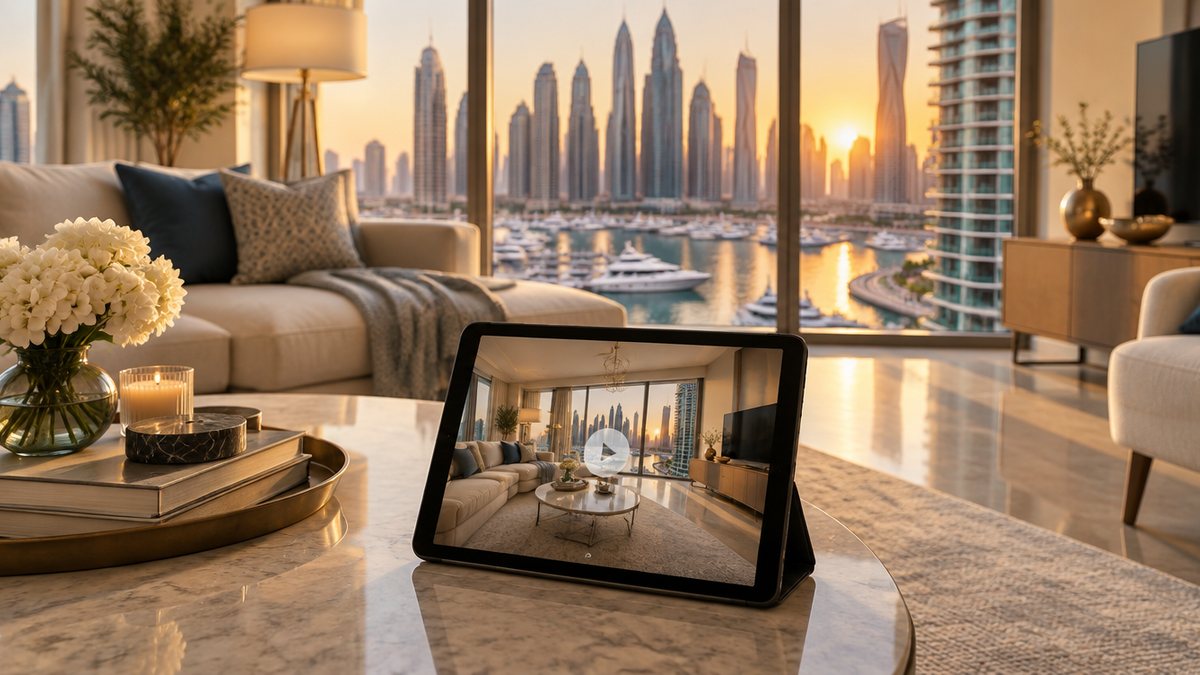
It costs a fraction of a shoot, AED 3,500 per social asset at published rates against AED 2,500 to 8,000 for a filmed walkthrough, and it still needs a Trakheesi permit like any property ad.
What an AI tour is, and what it is not
An AI tour is a linear video, not a 3D model and not a shoot. The source is whatever already exists for the listing: ten to twenty photos of a built unit, or the developer's approved renders and plans for off-plan.
Each source image is animated with image-to-video, which adds motion to a still while keeping its content, and the shots are cut together in the order a viewing runs.
The line it must not cross is inventing the property. Image-to-video keeps the room as photographed; text-to-video, which generates a scene from words alone, would invent one. For a built unit, the furniture, finishes, view and proportions in the video must be the ones in the photos, because the advert must match the permit (source: PropSpace) and because a buyer who flies in to find a smaller balcony is a lost deal and a complaint.
What may be generated is what a photo cannot show: the same living room at dusk, a figure at the window, the marina traffic moving, a slow reveal through the doorway. For off-plan, where nothing exists yet, the renders are the truth and the video adds life to them. Dubai sold AED 139.75 billion of off-plan property in the first half of 2026 (source: Emirates 24|7); that is the market an AI tour serves best.
What it costs against a videographer and a scan
Three price points cover property video in Dubai, and each buys a different thing. A filmed walkthrough from a videographer is published at AED 2,500 to 3,500 for a basic interior-only piece and AED 5,000 to 8,000 with drone and lifestyle shots; a luxury cinematic film runs AED 15,000 to 30,000 (source: SL Media).
Four Kings quotes architectural and real estate video at AED 8,000 to 25,000 (source: Four Kings UAE).
AI production is published at AED 3,500 per social asset of 15 to 60 seconds and AED 15,000 to 60,000 for a branded piece (source: JJ Agency Films); SL Media quotes AI property videos at AED 1,500 to 8,000 against AED 12,000 to 25,000 for a comparable shoot (source: SL Media). A professional Matterport 3D scan costs USD 350 to 1,000 for a residence, USD 750 to 2,000 for commercial space, plus about USD 20 a month per active space to host (source: The Future 3D).
| Option | Published price | What you get | Best for |
|---|---|---|---|
| Videographer walkthrough | AED 2,500 to 8,000 | 1 to 2 minute filmed tour, drone at the top of the range | Built units where the buyer will hold you to every frame |
| Cinematic property film | AED 15,000 to 30,000 | 2 to 4 minutes, twilight, drone orbits, presenter | Luxury villas, penthouses, developer flagships |
| Matterport 3D scan | USD 350 to 1,000 plus hosting | Navigable 3D model the buyer explores | Serious buyers of a built unit, remote viewings |
| AI property tour | AED 1,500 to 8,000 per SL Media; AED 3,500 per asset per JJ Agency | Linear video from photos or renders, in every format and language | Off-plan, volume across many listings, social reach, language versions |
The comparison that matters is per listing per month. A brokerage with twenty active listings cannot shoot twenty walkthroughs at AED 5,000 each; it can produce twenty AI tours from the photos it already has, and shoot the two that deserve it.
Why video at all: the enquiry numbers
The case for putting video on a listing is the strongest number in property marketing, and Dubai studios repeat it: listings with video receive about 403 percent more enquiries than listings without, a figure attributed to the National Association of Realtors (source: SL Media).
Bayut's own agent guidance states that listings with videos generate more leads on its platform, without a number (source: Bayut).
The gap is the opportunity. Most agents still list with photos only, so a listing with a tour stands out on a portal page before a buyer reads a word. Bayut accepts video on listings via YouTube, DailyMotion and Vimeo links, so the tour needs a 16:9 export hosted on one of those (source: Bayut), and a 9:16 cut for Reels, TikTok and WhatsApp.
Step 1: permit and source material
Get the permit before the pictures. Every property advertisement in Dubai, including on Instagram, Facebook, YouTube and WhatsApp, must carry a valid Trakheesi permit number from Dubai Land Department, with no exemption for digital formats; the number must be displayed on the ad, and fines start at AED 50,000 (source: EGSH).
The permit costs AED 1,020 and is processed within a working day. Brokers also need the owner's written Form A authorisation before marketing a unit (source: Built Environment ME).
Then collect the source. For a built unit, the ten to twenty best photos at the highest resolution available; portal listings already require a minimum of ten photos at 900 by 600, and larger is better because the video model inherits the photo's resolution. For off-plan, the developer's approved renders, the floor plan and any approved view shots. Photograph the actual view from the actual window; do not source a stock skyline.
Step 2: the shotlist
Write the tour in the order a viewing runs, ten shots, one source image each. Entrance and hallway; living room; kitchen; master bedroom; bathroom; balcony or window view; a second bedroom or study if the unit has one; building amenities such as pool or gym from the building's own photos; the street or community; the area landmark.
Each shot gets a duration of four to eight seconds and one camera move.
Assign the moves by what the room needs. A push in for the living room, a slow pan for the kitchen, an orbit for a feature such as a staircase, a reveal through a doorway for the master, a tilt up from the pool to the tower. Higgsfield offers these as named camera presets such as Dolly In and Crane Down that you select rather than describe (source: Higgsfield). The shotlist is also the credit budget: ten shots generated twice is twenty generations.
Step 3: generate with image-to-video
Every shot starts from its source photo with image-to-video, never from a text prompt, so the room cannot change. Veo 3.1 generates 4, 6 or 8 second clips from an image and supports first-and-last-frame generation (source: Google); Kling 3.0 offers image-to-video and start-and-end-frames-to-video at 3 to 15 seconds (source: Kling).
First-and-last-frame is the tool for travelling between two photos of the same room, say the doorway shot and the window shot, in one continuous move.
Generate each shot at least twice and keep the take where nothing drifted: check straight lines, tile joints, window frames and any text on signage, which are where generated motion shows its seams. Discard any take where a fixture moved or a wall changed. A property tour tolerates less artefact than an ad, because the viewer is checking the room.
Step 4: what you may add and what you may not
The allowed additions are the ones a photo cannot show and a buyer cannot be misled by. Time of day: the same room at golden hour, generated from the daytime photo with a light change. Life: a figure at the window, a kettle steaming, curtains moving. Context: the marina at dusk in the window, if that is the real view.
Reference images keep any added person consistent across shots; Veo 3.1 takes up to three (source: Google).
The forbidden additions are anything that changes what the buyer will get. No generated furniture in an empty unit unless it is labelled as virtual staging, no upgraded finishes, no wider rooms, no invented views, no amenities the building does not have. The advert must match the permit and the unit, and a generated pool in a tower without one is a RERA breach and a refund conversation. For off-plan, the same rule reads: nothing that is not in the approved renders.
Step 5: edit, label, export
Cut the tour to 60 to 90 seconds for the portal version and 15 to 45 seconds for social; SL Media's recommended lengths are 1 to 2 minutes for a walkthrough and 15 to 45 seconds for reels (source: SL Media).
Caption the essentials on screen: price, size, bedrooms, community, and the Trakheesi permit number in the frame rather than only in the description. Add an AI label; platforms may apply their own regardless.
Export 16:9 for YouTube or Vimeo, which is how Bayut attaches video to a listing (source: Bayut), and 9:16 for Instagram, TikTok and WhatsApp. Keep an asset record of which photo and which model made each shot, with the permit and Form A attached; it is what you produce if RERA or a buyer asks.
When you still need a videographer
Hire a videographer when the property is the product and the buyer will hold you to every frame. A finished villa above a few million dirhams, a penthouse, a developer's show unit: these earn a cinematic shoot at AED 15,000 to 30,000, with drone, twilight and a presenter (source: SL Media), because the buyer is paying for exactly what is on screen.
A Matterport scan belongs on the same listings for remote buyers who want to walk it themselves.
Use AI for everything a shoot cannot economically cover: off-plan, where there is nothing to film; the fifteen mid-market listings that would never get a crew; language versions of a shot film for Russian, Hindi or Arabic buyers; and the social layer of cutdowns and hooks from any of the above. The two are not rivals. The best-marketed listing in 2026 has a shot hero film, a scan and a dozen AI cuts.
How NotBoring does property tours
NotBoring is a Dubai creative production agency making cinematic and AI-generated video for brands across the GCC, and this is a seller's guide with other studios' published rates. For property, we work from the listing's own photos or the developer's approved renders, generate with image-to-video only, keep an asset record per shot, place the Trakheesi number in the frame, and quote on the number of listings, shots and languages.
The full picture for brokers and developers, including off-plan launches, is in the real estate guide (source: NotBoring).